
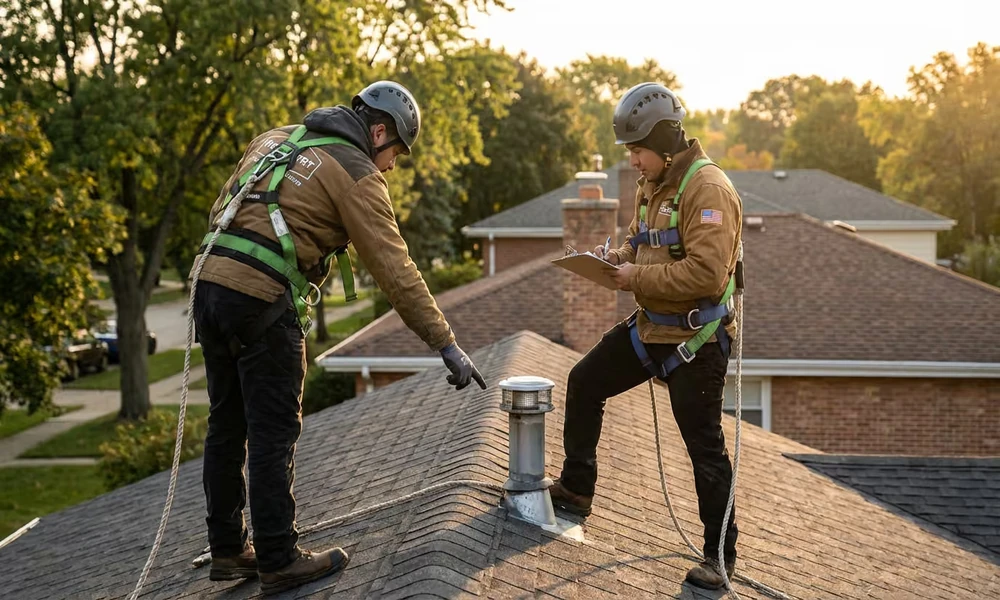
A homeowner in Fairfax calls a roofer about a brown stain spreading across a bedroom ceiling. The roofer climbs up and finds the shingles in reasonable shape, so he walks the eaves instead. The cause is a sagging gutter that has been spilling water behind the fascia for two winters. That water soaked into the edge of the roof deck and then traveled down inside the wall. The stain was on the ceiling, but the problem started three feet away on a different part of the house.
Stories like this are common enough that some contractors no longer treat roofs, siding, gutters and windows as separate jobs. Firms such as Beyond Exteriors, which has worked on Northern Virginia homes since 2010, look at the outside of a house as one connected system. A weakness in one layer usually shows up as damage in another, often somewhere you wouldn’t think to look.
Planning the whole exterior doesn’t have to mean spending more. Often it means paying for a repair once instead of twice. Following two homeowners through the same problem shows why.
Two Neighbors and One Leaky Ceiling
Picture two identical colonials on the same street, both built in the late 1990s and both developing a ceiling stain in the same week.
The first owner hires whoever can come fastest. A crew replaces a patch of shingles around the stain, charges a fair price and leaves. The stain dries out. Eighteen months later it returns, now with a soft spot in the drywall, because the gutter was never touched and the rotted fascia board kept channeling water inward.
The second owner asks a different question. Instead of “Can you fix the roof?” she asks, “Why is water getting in here?” The inspection takes longer. It covers the gutter pitch, the fascia, the step flashing where the roof meets a dormer wall, and the attic above the stain. The repair costs a bit more on day one. She doesn’t have to pay for it again in two years.
The difference between them isn’t money or luck. It’s the question each one asked.
Water Never Respects Trade Boundaries
Rain falling on a house passes through several systems on its way to the ground, and each one has to hand it off cleanly to the next. When you follow a single drop down, the reason for whole-house thinking becomes obvious.
- It lands on shingles, metal or slate, which shed it downhill as long as the surface is intact and properly lapped.
- It meets flashing at chimneys, skylights, valleys and sidewalls, where most roof leaks actually begin.
- It runs off the drip edge and into the gutter. If the gutter is pitched wrong or clogged, water overflows behind it and soaks the fascia.
- It travels through downspouts that should discharge several feet from the foundation, not right beside it.
- Wind-driven rain hits the siding, which keeps out most water, while the house wrap behind it handles what gets past.
- Around windows and doors, flashing tape and sill pans direct any water that gets in back outside.
When one handoff fails, the next layer takes water it was never built to handle. That’s why a roofer who never looks at the gutters, or a siding crew that never checks the window flashing, can do excellent work and still leave you with a leak.
The Attic Is Where Heat and Moisture Collide
Most homeowners never go into the attic, yet it decides how long the roof above it will last. A poorly insulated attic lets warm air from the living space rise into it. In winter, that heat melts snow on the upper roof, the meltwater refreezes at the colder eaves, and ice dams push water back up under the shingles. In summer, an attic with poor ventilation can get hot enough to speed up shingle aging from below.
Insulation and air sealing also pay off directly. The EPA estimates that sealing air leaks and adding attic insulation can cut heating and cooling costs by about 15 percent on average. That saving depends on the roof’s ventilation working together with the insulation. Blowing in insulation that covers the soffit vents can trap moisture and grow mold on the underside of the roof deck. The two have to be planned together.
Windows and Siding Share More Than a Wall
Windows and siding meet at the trim, and that’s where poor timing gets expensive. If you replace siding now and windows three years later, the installers will likely have to remove and redo the trim and the siding around every opening. Doing both together lets the crew flash each window into the new house wrap as one continuous water barrier.
Material choice works the same way. Fiber cement handles moisture and impact well but needs careful painting at cut ends. Vinyl is lighter and cheaper, but it expands and contracts a lot with temperature, so window trim has to leave room for that movement. A good plan picks a window style and a siding product that work well together.
Why Northern Virginia Weather Raises the Stakes
The region’s climate is hard on a house’s exterior in every season. Summers are hot and humid, with thunderstorms that bring sudden downpours, gusty winds and sometimes hail. Winters swing above and below freezing many times, so any water that seeps into a crack expands, widens it, and comes back the next night. Mature oaks and maples, common in older neighborhoods, fill gutters every fall and drop branches during storms.
All of this puts stress on the connections between systems more than on the materials themselves. Shingles tend to outlast the flashing beside them, and siding often outlasts the caulk around the window next to it.
Sequencing a Project So Nothing Gets Torn Up Twice
If several parts of the exterior are aging together, the order of the work matters as much as the materials. Roofing usually comes first, since gutters often have to come down to install new drip edge properly. Gutters go back up once the roof edge is finished. Window replacement should come before or alongside siding, never after. Attic insulation is best done once the roof ventilation plan is settled, so the two are designed together.
Phasing is fine when the budget won’t stretch to everything at once. What matters is that the phases follow a plan, so the second project doesn’t undo the first.
When a Single Repair Really Is Enough
Not every problem needs a whole-house review. A shingle tab torn off in a windstorm, one cracked siding panel from a stray baseball, or a downspout knocked loose by a ladder are isolated problems with isolated fixes. Turning those into a full exterior project would be overselling.
The test is whether you can explain why the problem happened. If the cause is obvious and limited to one spot, fix that spot. If the same stain, draft or drip keeps coming back, it’s coming from somewhere else, and the house is telling you to look at how its parts connect.