
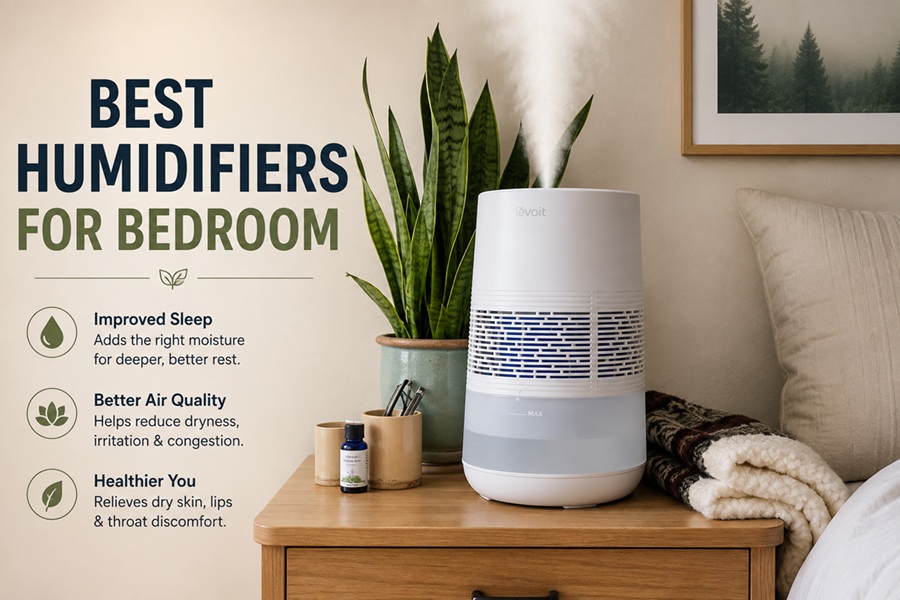
The best humidifiers for a bedroom are cool-mist models with a quiet ultrasonic motor, a tank large enough to run 8-12 hours overnight without a refill, and coverage that matches your room size. For most bedrooms under 400 square feet, a mid-size ultrasonic cool-mist unit with a built-in humidistat hits the right balance of quiet operation, low maintenance, and steady moisture output.
Dry bedroom air shows up in small, annoying ways — a scratchy throat when you wake up, static in your hair, skin that feels tight before you’ve even gotten out of bed. A good humidifier fixes this quietly in the background, but picking the right one means looking past marketing claims and focusing on a handful of specs that actually matter for sleep.
Quick Comparison: Humidifier Types for Bedrooms
| Type | Noise Level | Best For | Maintenance |
|---|---|---|---|
| Ultrasonic (cool mist) | Very quiet | Most bedrooms | Weekly cleaning |
| Evaporative | Low hum | Larger rooms | Filter replacement |
| Warm mist / steam | Quiet | Winter colds, dry sinuses | Simple, but hot to touch |
| Whole-house (furnace-mounted) | Silent | Whole home, not just bedroom | Seasonal service |
Ultrasonic cool-mist units are the most common choice for bedrooms specifically because they run near-silently, which matters more at 2 a.m. than it does in a living room.
What Actually Matters When Choosing One
Not every spec on the box is worth caring about. A few features make a real difference for bedroom use, and a few are mostly noise.
- Tank size — A 4 to 6-liter tank usually covers a full night without needing a refill
- Room coverage rating — Match this to your actual square footage, not the size of the box
- Noise output — Look for units rated under 30 decibels for sleep-friendly operation
- Auto shut-off — Prevents the unit from running dry and overworking the motor
- Built-in humidistat — Keeps humidity in a healthy range automatically instead of guessing
Features like colored night lights or aromatherapy trays are nice extras, but they don’t affect how well the unit actually humidifies a room.
Cool Mist vs. Warm Mist: Which Is Better for a Bedroom
This is usually the first fork in the decision, and it comes down to personal comfort rather than one being objectively better.
| Factor | Cool Mist | Warm Mist |
|---|---|---|
| Energy use | Lower | Higher (heats water) |
| Safety around kids/pets | Safer | Hot surface, more caution needed |
| Winter congestion relief | Neutral | Often preferred |
| Mineral buildup | More common | Less common (boiling kills bacteria) |
| Room cooling effect | Slight cooling | Slight warming |
Cool mist tends to be the safer default for most bedrooms, especially shared rooms or homes with kids. Warm mist has a following among people who deal with winter colds or sinus pressure, since the warm vapor can feel more soothing.
Matching a Humidifier to Your Bedroom Size
Coverage ratings on the box are often generous, so it helps to size up rather than down if you’re between two options.
| Bedroom Size | Recommended Tank Size | Recommended Coverage |
|---|---|---|
| Small (under 200 sq ft) | 1-2 liters | Up to 250 sq ft |
| Medium (200-350 sq ft) | 3-4 liters | Up to 400 sq ft |
| Large (350-500 sq ft) | 5-6 liters | Up to 500 sq ft |
| Master suite / open layout | 6+ liters | 500+ sq ft |
A humidifier that’s undersized for the room will run constantly and still underperform, which usually shortens its lifespan and increases how often you’re cleaning it.
Top Picks by Category
Rather than naming a single “best” humidifier, it’s more useful to match the right pick to how you’ll actually use it.
Best for quiet operation: Look for ultrasonic models specifically marketed for nurseries or bedrooms — brands like Levoit and Honeywell have several models built around low decibel output as the main selling point.
Best for small rooms or nightstands: Compact cool-mist units, such as smaller Vicks or Crane models, are sized to sit on a nightstand or dresser without taking up floor space.
Best for larger bedrooms: Bigger-tank ultrasonic units, like the higher-capacity Levoit and Vornado lines, are built to cover 400-500 square feet without needing a midnight refill.
Best for winter congestion: Warm mist or steam-based units work well here, since the heated vapor can feel more soothing for a stuffy nose or dry throat.
Best premium option: Higher-end air treatment devices, like Dyson’s combined purifier-humidifier models, add filtration on top of humidification, though they come at a noticeably higher price point.
Signs Your Bedroom Actually Needs a Humidifier
Not every bedroom needs one year-round. A few signals suggest it’s worth adding:
- Waking up with a dry or scratchy throat
- Static shocks when touching metal doorknobs
- Cracked skin or lips that lotion doesn’t fully fix
- Indoor humidity below 30%, especially common in winter with heating systems running
- Worsened allergy or asthma symptoms overnight
If none of these apply, you may not need one — over-humidifying a room can create its own problems, like mold growth or musty smells.
Maintenance Tips That Extend the Life of Your Humidifier
A humidifier that isn’t cleaned regularly can actually make bedroom air quality worse, not better.
| Task | How Often |
|---|---|
| Empty and rinse tank | Daily |
| Deep clean with vinegar solution | Weekly |
| Replace filter (if applicable) | Every 1-3 months |
| Use distilled or filtered water | Every refill |
Tap water is the biggest culprit behind the white dust some humidifiers leave on furniture — it’s mineral residue from hard water. Switching to distilled water solves this almost entirely.
Common Mistakes to Avoid
- Running the humidifier all night at max setting, which pushes humidity too high
- Skipping the weekly cleaning, which lets bacteria and mold build up in standing water
- Placing the unit directly on carpet or wood flooring without a mat underneath
- Choosing a unit based only on price, without checking noise ratings
- Ignoring room size and buying a unit too small for the space
Most of these are easy to fix once you know what to look for — the corrections often just mean adjusting a setting or moving the unit a few feet.
Frequently Asked Questions
What humidity level is ideal for a bedroom?
Most experts recommend keeping bedroom humidity between 30% and 50%. Below that, air feels dry; above it, you risk condensation and mold growth.
Is cool mist or warm mist better for sleep?
Both work for general comfort, but cool mist is usually the safer, lower-maintenance choice for most bedrooms, while warm mist is often preferred during cold and flu season.
How often should I clean my bedroom humidifier?
A quick rinse daily and a deeper clean with a vinegar solution weekly will prevent mold and mineral buildup in most units.
Can a humidifier make a bedroom too humid?
Yes. Running a humidifier constantly on a high setting without a built-in humidistat can push humidity above 50%, which creates a good environment for mold and dust mites.
Do humidifiers help with allergies?
They can help by keeping nasal passages and skin from drying out, but they don’t remove allergens from the air. For allergy relief specifically, an air purifier addresses a different part of the problem.
Final Thoughts
The right humidifier for a bedroom comes down to matching tank size and coverage to your room, keeping noise low enough to sleep through, and staying on top of basic cleaning. Beyond that, the differences between cool mist and warm mist, or between budget and premium models, mostly come down to personal comfort rather than one option being objectively correct. Start with your room size and noise tolerance, and the right category of humidifier usually becomes obvious from there.